Official Texas Marriage & Divorce Records Hub

Texas Marriage & Divorce Records Directory

Welcome to the official state directory for Marriage & Divorce Records. Access comprehensive local archives, review statutory compliance requirements under Tex. Family Code Ch. 2 & Health & Safety Code § 194, and locate certified government portals for major jurisdictions without third-party broker fees.
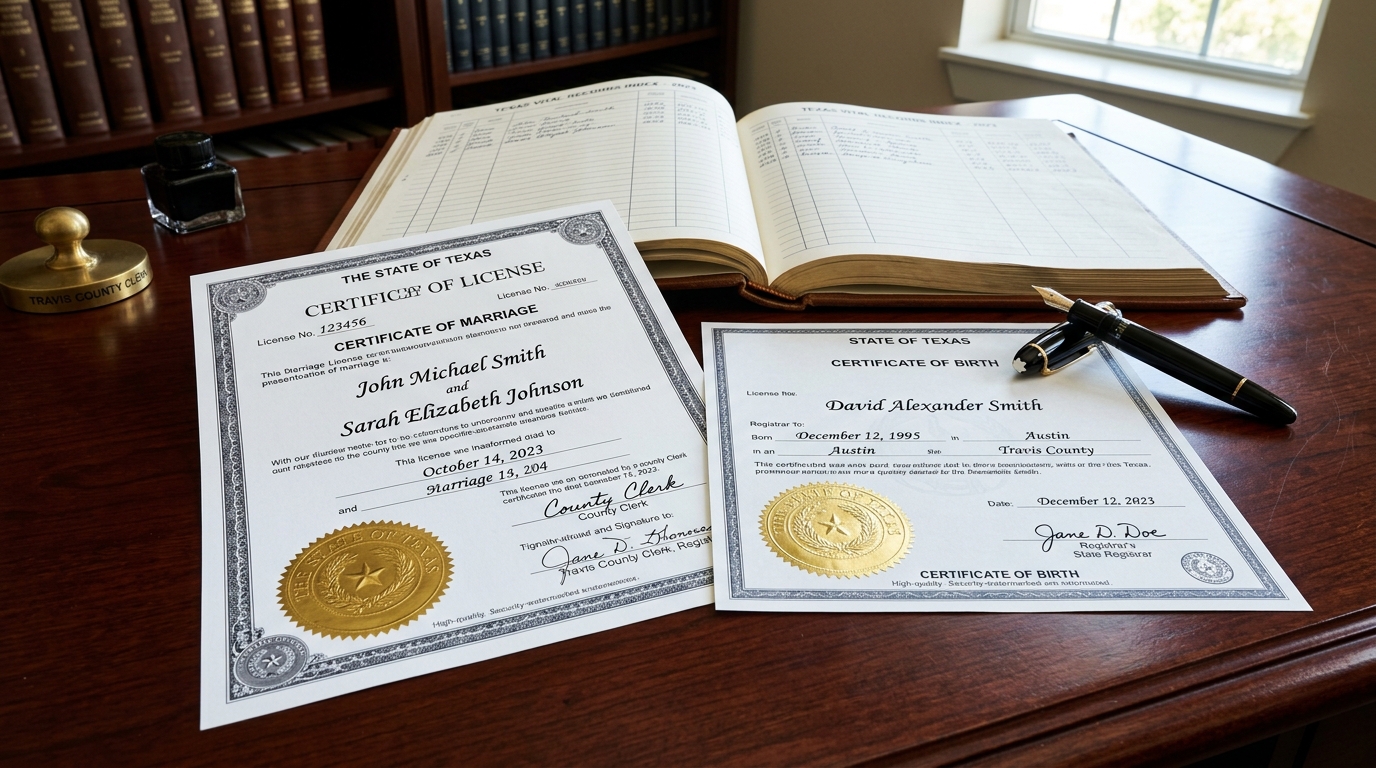
Texas Marriage & Divorce Records
Texas Marriage & Divorce Records Official Public Records Resource • texasrecordshub.org
Jurisdiction Directory

Select Your Texas County

Select any county below to view direct records portals, clerk contacts, courthouse addresses, and filing instructions.

8 Major Counties Available
Statutory Governance

Texas Legal Framework for Marriage & Divorce Records

Navigating legal requirements, administrative custodian rules, and public disclosure rights under state statutes.

The Presumption of Public Transparency in Texas

The fundamental policy of Texas law establishes that governmental bodies serve as custodial trustees of records, while true ownership resides with the public.

Enacted under Chapter 552 of the Texas Government Code, the statute mandates that all documents maintained by public entities are presumed accessible for inspection during normal business hours.

Core Public Entitlements

  • No Inquiry Into Purpose: Custodians are prohibited from asking why you desire the record.
  • Equal Standing: Residents, journalists, and legal researchers possess identical statutory access rights.
  • Decentralized Archives: Each of the 254 counties operates its own independent database repository.

Because Texas operates without a single real-time statewide database, identifying the specific county department holding your file is essential for timely document retrieval.

Custodial Divisions: District Clerk vs. County Clerk

Texas features a dual-clerk constitutional model. Understanding which clerk holds your specific record category prevents misdirected requests and administrative delays.

District Clerk Jurisdiction

  • Felony criminal indictments and trial dockets
  • Civil claims with significant financial controversy
  • Family legal proceedings and final divorce decrees
  • Grand jury records and appellate transfers

County Clerk Jurisdiction

  • Real property deeds, mortgage liens, and title transfers
  • Misdemeanor Class A and B criminal filings
  • Probate wills, estate administration, and guardianship
  • Certified marriage licenses, birth, and death certificates

Routing your request directly to the correct clerk ensures compliance with local filing deadlines and expedites document delivery.

Statutory Timelines & The 10-Business-Day Mandate

Texas Government Code § 552.221 requires public agencies to produce public files promptly upon receiving a formal written application.

When file indexing, archiving, or redaction prevents immediate delivery, the agency must take one of three formal statutory actions within ten business days:

  1. Complete Delivery: Furnish certified physical records or digital PDF files to the applicant.
  2. Written Delay Notice: Certify in writing that files cannot be released in ten days, stating the specific date and hour of production.
  3. Attorney General Appeal: Submit a formal legal brief to the Texas Attorney General requesting an Open Records Decision.

If a governmental body fails to request an Attorney General ruling within the strict ten-day deadline, the documents are conclusively presumed open to the public.

Statutory Redactions and Privacy Protections

While Texas maintains strict sunshine rules, explicit legislative carve-outs protect personal citizen privacy and sensitive law enforcement records.

Protected Information Categories

  • Social Security Numbers: Withheld under Texas Government Code § 552.147 without requiring an Attorney General brief.
  • Financial Credentials: Bank numbers, debit cards, and routing codes redacted under § 552.136.
  • Juvenile Law Files: Under Texas Family Code § 58.007, youth case records are strictly confidential.
  • Investigatory Work Product: Ongoing police work notes protected under § 552.108 until final case conclusion.

Whenever an agency applies redactions, it must furnish the applicant with an itemized notice citing the exact legal statute supporting each redaction.

Commercial Data Aggregators vs. Official Certified Portals

Private background check platforms frequently harvest public indexes, creating commercial profiles that often contain outdated or inaccurate information.

Under the federal Fair Credit Reporting Act (15 U.S.C. § 1681), commercial aggregator data cannot legally be used for employment vetting or tenant screening without strict dispute verification.

Advantages of Official Government Portals

  • Official Seals: Certified documents bearing clerk stamps accepted in all Texas courts.
  • Zero Broker Fees: Direct access eliminates recurring monthly commercial subscription costs.
  • Real-Time Verification: Reflects expunctions, non-disclosure orders, and recent dismissals accurately.

Conducting research via verified county clerk portals listed on texasrecordshub.org protects you from erroneous information and costly broker charges.

Statutory Fee Schedules & Cost Calculations

Texas Administrative Code Title 1, Part 3, Chapter 70 caps public reproduction rates to ensure records remain accessible to all citizens:

Record Material / Service Statutory Citation Authorized Rate Standard Timeframe
Standard Paper Copies (Letter/Legal) 1 TAC § 70.3(c) $0.10 per physical page Immediate to 5 business days
Certified Clerk Seal / Authentication Tex. Loc. Gov't Code § 118.014 $5.00 per certificate document Same day in-person / 3-5 days mail
Electronic Transmission (Email/PDF) Tex. Gov't Code § 552.261 Free (if under 50 pages) Immediate to 10 business days
Personnel Labor Charge (Requests > 50 pages) 1 TAC § 70.3(d) $15.00 per staff hour Variable depending on archive size
Court Case Docket Search Index TRCP Rule 76a / OCA Free digital access on county terminals Instant public access

If estimated expenses exceed $40.00, the custodian must provide an itemized cost estimate in writing before compiling documents, allowing you ten business days to accept or modify your request.

Legal & Practical Answers

Frequently Asked Questions

Key legal and administrative questions regarding Texas marriage & divorce records access.

Are all marriage & divorce records open to the public without exception?

While the Texas Public Information Act presumes openness, statutory exceptions apply. For example, active law enforcement investigation files, juvenile criminal proceedings, mental health commitments, and documents sealed by judicial order under Texas Rule of Civil Procedure 76a remain strictly confidential.

How quickly must a Texas county clerk or agency fulfill a records request?

Agencies must produce available records promptly. When records require extensive retrieval, indexing, or redaction, the agency must provide written notification within 10 business days establishing a certified date of delivery or seek an Attorney General ruling under § 552.301.

Is in-person physical inspection of public records free of charge?

Yes. Under Texas Government Code § 552.271, physical inspection of records maintained in standard paper formats or on public terminal stations is free of charge. Charges apply only if reproduction copies, certified seals, or labor-intensive manipulation is required.

What recourse exists if a county agency improperly denies record access?

Citizens can contact the Texas Attorney General Open Government Hotline, file an administrative complaint with the Public Information Coordinator, or petition a Texas District Court for a writ of mandamus under § 552.321 to compel statutory disclosure.